 Kilimanjaro Climbing Tours
Best Time to Climb Kilimanjaro: Months, Rain and Summit Temperatures
The best time to climb Kilimanjaro comes down to two dry seasons and two rainy seasons, and and the choice shapes the rain and the crowds you meet. This page sets out the months, the rain, the crowds and the temperature by altitude zone, from the forest at 1,800 m to the arctic zone at 5,895 m. It also covers the summit cold and wind, and which side of the mountain stays drier in the wet months. If you are still comparing Kilimanjaro climbing tours, the season you pick should come first, because it shapes the route and the crowds you will meet.
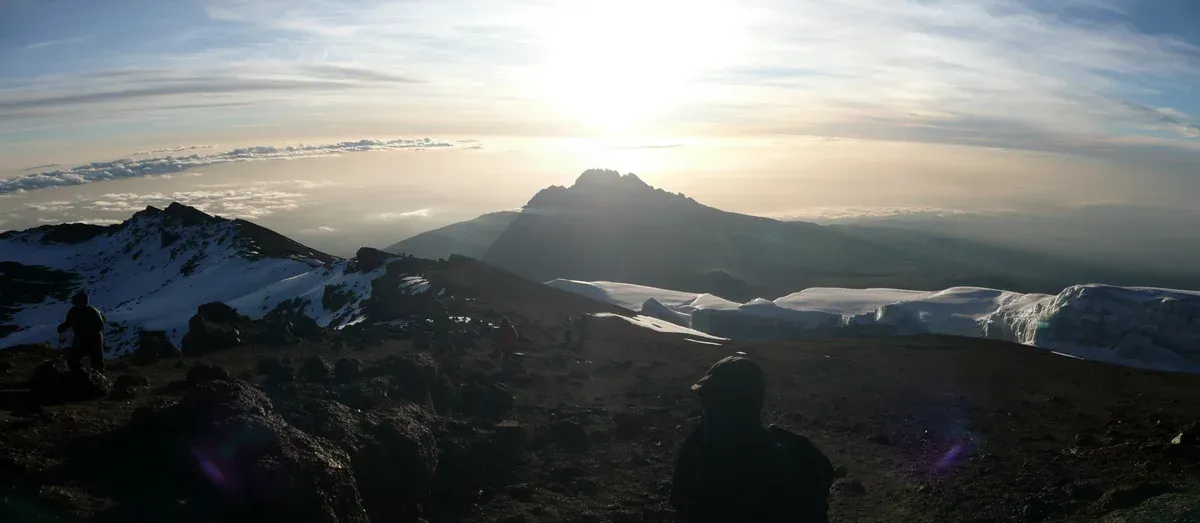
Mawenzi at sunrise from the crater rim. Photo: Sbork, CC BY-SA 3.0, via Wikimedia Commons
Quick answer The short answer
The best months to climb Kilimanjaro are January to mid-March and June to October, the two dry seasons given by Altezza Travel. Wikipedia dates the rainy seasons as March to May and around November. Follow Alice names July, August and September as the busiest months and Altezza Travel calls April the quietest.
Key takeaways
- February is the warmest month with minimal rain according to Altezza Travel, so a 7-day Lemosho climb starting then is a solid pick.
- June to October is dry but busy, so a Wednesday or Thursday start cuts the crowd roughly in half per Altezza Travel. See the routes compared.
- Operators point to the drier north side in the wet months, so the Rongai Route 7 Days is the one to look at for May.
- Expect minus 20 to minus 10 degrees Celsius at night in the arctic summit zone per Duma Explorer. Read about summit night and altitude.
Month by Month
Kilimanjaro can be climbed year round, but rain and crowds swing hard between seasons. The table below pulls together the season boundaries from Altezza Travel and Wikipedia with the rainfall ratings and crowd levels those sources give.
The Two Dry Seasons and the Two Rainy Seasons
Altezza Travel gives the dry seasons as January to mid-March and June to October, and the rainy seasons as late March to May and November to late December. Wikipedia puts the rainy seasons slightly differently, at March to May and around November. Adventure Consultants names January to March and June to October as the two climbing seasons and avoids April, May and November altogether. Follow Alice says the best months are June to October and December to March, with July, August and September the busiest.
The long rains have a local name and a rough calendar. Duma Explorer dates them, called Masika, from about 25 March to 21 May. Moshi itself receives about 71 percent of its annual rain between March and May according to Wikipedia, so the wet season is not a mountain-only pattern. In the dry season the snow line matters too. Altezza Travel says snow on the summit is visible almost always except from July to October.
| Months | Season | Rain | Crowds |
|---|---|---|---|
| January to mid-March | Dry season | Low in January and February per Duma, though Altezza notes recent years brought more rain than expected in these months | Not stated in the sources |
| Late March to May | Long rains (Masika) | High in May and very high in April per Duma Explorer | Quiet, April is the quietest month per Altezza |
| June to October | Dry season | Low in June and September, very low in July and August per Duma | Busy, July to September the busiest per Follow Alice, August one of the busiest per Altezza |
| November to late December | Short rains | Around November per Wikipedia, October to December per Duma | Quiet |
February and the Shoulder Months
Altezza Travel calls February the warmest month with minimal rain, which makes the January to mid-March window attractive even though the same source warns that January and February have recently brought more rain than expected. Altezza Travel says summit snow is visible almost always except from July to October, so this window falls in the snowy part of the year.
June is the transition out of the long rains. Duma Explorer rates its rainfall as low, and Altezza Travel recommends Rongai in May for its drier northern side, which makes the north side the option to ask about for May. Duma Explorer rates September rainfall as low. For a budget read on what any of these months costs, see the page on the cost to climb Kilimanjaro.
Sources: Altezza Travel, Wikipedia, Duma Explorer, Follow Alice, Adventure Consultants
Kilimanjaro Weather by Zone
Kilimanjaro packs several climate bands into one climb, so weather questions are really altitude questions. The figures below come from Duma Explorer's zone guide, with summit averages from Wikipedia and night-time detail from Follow Alice.
From Rainforest to Arctic
The climb starts in the rainforest zone at 1,800 to 2,800 m, where Duma Explorer records 2,000 to 3,000 mm of rain a year. Wikipedia gives 800 to 900 mm a year on the lower southern slope against 250 to 500 mm at the summit, where most precipitation falls as snow and graupel.
Above the forest the moorland zone runs from 2,800 to 4,000 m with night temperatures of 0 to 5 degrees Celsius. Zara Tours' Machame listing says night temperatures can already reach freezing at Machame Camp, so pack warm sleeping gear. From 5,000 m to the top, Duma Explorer's arctic zone brings night temperatures of minus 20 to minus 10 degrees Celsius. Wikipedia gives the average summit temperature as about minus 7 degrees Celsius (19 F).
| Zone | Altitude | Temperature |
|---|---|---|
| Rainforest | 1,800 to 2,800 m | 2,000 to 3,000 mm of rain a year per Duma Explorer |
| Moorland | 2,800 to 4,000 m | Nights of 0 to 5 C per Duma Explorer, already freezing at Machame Camp per Zara Tours |
| Alpine desert | 4,000 to 5,000 m | Not stated |
| Arctic summit zone | 5,000 to 5,895 m | Nights of minus 20 to minus 10 C per Duma Explorer, average about minus 7 C (19 F) per Wikipedia |
How Cold the Summit Gets
The summit cold depends on the month. Duma Explorer gives typical summit temperatures of minus 15 to minus 20 degrees Celsius in June, July and August, and minus 7 to minus 12 degrees Celsius in January, February and December. Follow Alice says night temperatures on the summit push can drop to minus 10 degrees Celsius or lower near the crater rim.
Wind is the part most climbers underestimate. Duma Explorer says winds of 40 to 50 km/h on the upper slopes can make it feel about 20 degrees Celsius colder than the air temperature. Follow Alice's schedule has climbers leaving base camp around midnight from camps typically at 4,600 to 4,800 m, spending hours in the coldest part of the day, and expecting only about 15 minutes at the top before descending. Dress for those hours, not for the 15 minutes. The routes and camps are laid out on the page covering climbing Mount Kilimanjaro.
Sources: Duma Explorer, Wikipedia, Follow Alice, Zara Tours
Picking Dates and a Route
Once you know the season, two choices do the heavy lifting: your start day of the week and the side of the mountain you climb. Both figures below come straight from operator guidance.
Start Days and Crowds
Altezza Travel says starting on a Wednesday or Thursday means about half the crowd of other days. That matters most in the busy window from June to October, when Follow Alice names July, August and September as the busiest months and Altezza calls August one of the busiest on the mountain. April is the quietest month per Altezza, but Duma Explorer rates April's rainfall as very high, so the trade is solitude against mud and cloud.
Crowds also bunch on the popular paths. A private 7-day Lemosho Route climb at $3,959 per person is the 7-day option compared here, and an 8-day Northern Circuit climb at $4,554 per person is described by its operator as the longest route with few other trekkers. How many days each route needs is covered on the page about how long it takes to climb Kilimanjaro.
The North Side in the Wet Months
Rongai starts on the north side near the Kenyan border and is the only route that approaches from the north, according to Duma Explorer. That geography is the whole argument for climbing it in the shoulder months. Much Better Adventures suggests Rongai as the best option in the shoulder months because the north side gets less rain, and Altezza Travel recommends Rongai in May for its drier northern side.
Two bookable options cover it. Altezza Travel's private Rongai Route 7 Days costs $3,993 per person, rated 5.0 from 57 reviews, and a budget version runs 7 days at $2,000 per person with park fees included and hotel nights in Moshi left out. If you would rather climb in the dry season instead of working around the rain, a 6-day Machame Route climb at $2,350 per person with park and rescue fees included suits the dry months from June to October, ideally with a midweek start.
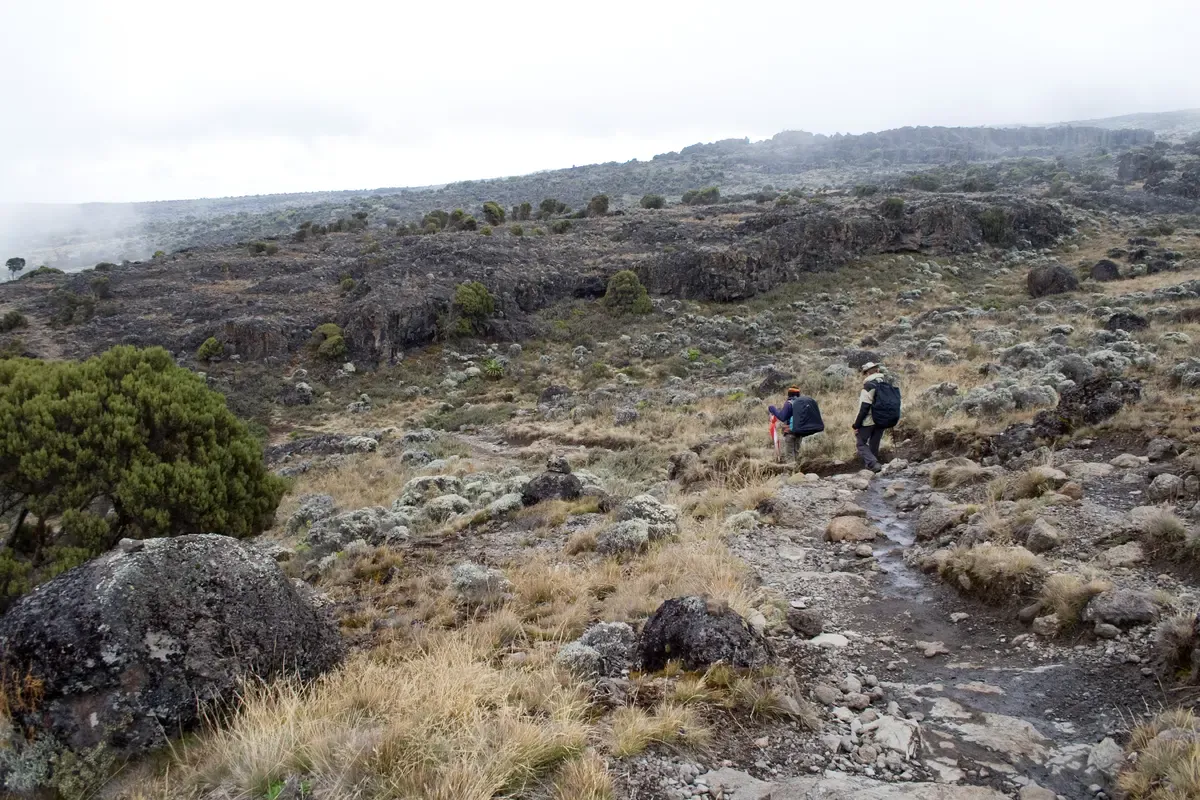
The Shira Plateau. Photo: Stig Nygaard, CC BY 2.0, via Wikimedia Commons
Season and Weather Tips
Do
- Do start on a Wednesday or Thursday because Altezza Travel says those start days mean about half the crowd of other days.
- Do look at Rongai for May because Altezza Travel recommends its drier north side then, and Much Better Adventures suggests it in the shoulder months.
- Do pack for minus 20 degrees Celsius at night because Duma Explorer gives arctic zone nights of minus 20 to minus 10 C and Follow Alice says the summit push runs through the coldest hours.
- Do bring windproof layers because Duma Explorer says 40 to 50 km/h winds on the upper slopes can make it feel about 20 C colder than the air temperature.
- Do pack rain gear for the forest zone because Duma Explorer records 2,000 to 3,000 mm a year there at 1,800 to 2,800 m.
Don't
- Don't plan on summit snow photos from July to October because Altezza Travel says the snow is visible almost always except in those months.
- Don't assume January and February are bone dry because Altezza Travel warns those months have recently brought more rain than expected.
- Don't book April for the quiet trails without accepting the rain because Altezza calls it the quietest month while Duma Explorer rates its rainfall very high.
- Don't treat the dry seasons as guaranteed because the two sources differ slightly, with Wikipedia giving the rains as March to May and around November and Altezza extending them to late March to May and November to late December.
Best Time to Climb Kilimanjaro: Questions
What month is best to climb Kilimanjaro?
February is the warmest month with minimal rain according to Altezza Travel, and July and August are rated very low rainfall by Duma Explorer and September low, but July to September are the busiest. June and September are also rated low rainfall, and a Wednesday or Thursday start halves the crowd per Altezza. Compare itineraries on the page covering climbing Mount Kilimanjaro.
When is the Kilimanjaro rainy season?
Wikipedia gives the rainy seasons as March to May and around November, while Altezza Travel extends them to late March to May and November to late December. The long rains carry a local name, Masika, dated by Duma Explorer from about 25 March to 21 May. Route choices for wet months are covered on the page about Kilimanjaro routes.
How cold is it at the top of Kilimanjaro?
Wikipedia gives the average summit temperature as about minus 7 degrees Celsius (19 F), and Duma Explorer gives arctic zone nights of minus 20 to minus 10 C. June, July and August summits run minus 15 to minus 20 C according to Duma Explorer. The peak itself is described on the page about Uhuru Peak.
Can you climb Kilimanjaro in the rainy season?
Yes, operators sell climbs year round, but Duma Explorer rates April's rainfall as very high and May as high, and about 71 percent of Moshi's annual rain falls from March to May per Wikipedia. The north side is the usual answer, which Much Better Adventures recommends in the shoulder months and Altezza Travel recommends for May, such as the Rongai Route 7 Days.
When is Kilimanjaro least crowded?
April is the quietest month according to Altezza Travel. In the busy dry season, starting on a Wednesday or Thursday means about half the crowd of other days per Altezza. Longer, quieter paths are compared on the page listing Kilimanjaro routes.
Does the season change the cost of climbing Kilimanjaro?
The prices in this comparison are the listed per-person rates and the sources used here give no seasonal price changes, but what you add around them can vary, since hotel nights, tips and gear can sit outside a package. A dry-season pick like the Lemosho Route 7 Days at $3,959 per person includes park fees and 2 hotel nights, while other listings leave hotel nights out, as the budget Rongai climb does. The full breakdown is on the page about the cost to climb Kilimanjaro.