 Kilimanjaro Climbing Tours
Uhuru Peak: The Summit of Kilimanjaro and of Africa
Uhuru Peak is the highest point of Mount Kilimanjaro and of the whole African continent, standing at 5,895 m (19,341 ft) on the rim of the Kibo crater. This page covers the summit itself: its height, its name, its history, Stella Point and Gilman's Point, and what summit night is like from the last camps. If you want the general height of the mountain, its cones and its prominence, that belongs on the page about Mount Kilimanjaro height. If you are choosing between routes and prices, the Kilimanjaro climbing tours homepage compares the bookable climbs that end on this point. The figures below come from Tanzania National Parks Authority and UNESCO figures cited by Wikipedia, from named operators and from climbing record sites, and where sources disagree, both sides are given.
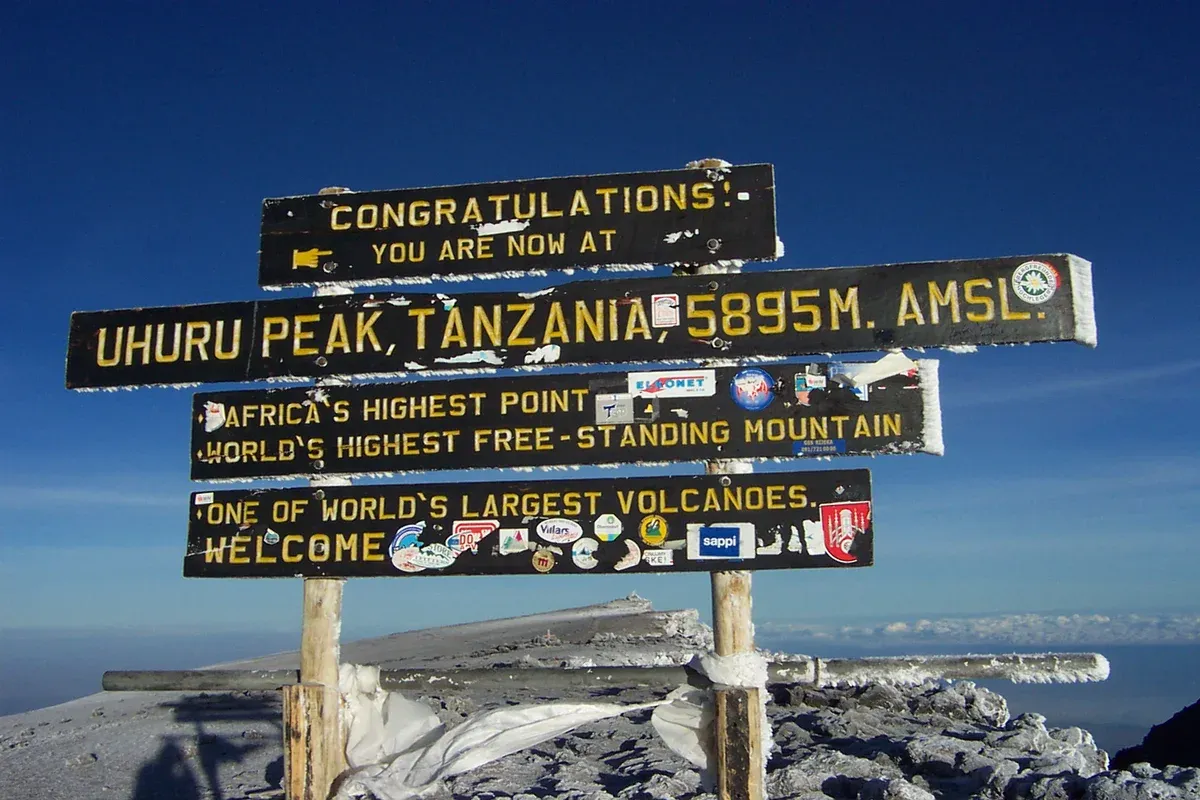
The Uhuru Peak summit sign. Photo: Arne (assumed), public domain, via Wikimedia Commons
Quick answer Uhuru Peak at a glance
Uhuru Peak is the summit of Kilimanjaro, at 5,895 m (19,341 ft) on the crater rim of the dormant volcano Kibo, and it is the highest point in Africa. Per Footslopes Tours, the night walk to the rim takes 6 to 8 hours, followed by 30 to 60 minutes along the rim. The name is Swahili for freedom. Summit temperatures run from -5 to -20 °C according to Footslopes Tours.
Key takeaways
- The summit sits on Kibo's rim, reached via Stella Point on the Machame, Lemosho and Umbwe listings here, or via Gilman's Point on the Marangu and Rongai listings.
- See the routes compared on the homepage to decide which path to the rim suits your schedule.
- The Northern Circuit Route 8 Days is the longest and quietest line to the summit, at $4,554 per person with park fees included.
- Timings, camps and certificates for summit night are covered in the seasons and altitude section of the homepage.
The Summit and Its Name
Uhuru Peak is a point on the rim of Kibo, the highest of Kilimanjaro's three volcanic cones. This block covers how the summit was first climbed, how it got its name and the records attached to it.
A Short History in Dates
The first ascent was made by Hans Meyer and Ludwig Purtscheller on 6 October 1889, a date that happened to be Purtscheller's 40th birthday according to Wikipedia. The local guide Yohane Lauwo was with the party, and Wikipedia notes that Yohani Lauwo is sometimes suggested as a co-first-ascendant, though a 1989 centenary committee only concluded he was on Meyer's team. Meyer had turned back at the base of Kibo in 1887 and reached the summit on his third attempt. He named the summit Kaiser-Wilhelm-Spitze, a name that stayed until after the First World War.
The modern name dates from around independence. Uhuru is Swahili for freedom, and Ultimate Kilimanjaro records that Lieutenant Alexander Nyirenda planted Tanganyika's new flag and lit the Uhuru Torch on the summit on 8 December 1961, fulfilling Julius Nyerere's quoted promise that the nation would light a candle on top of the mountain. When the peak was renamed is disputed: Ultimate Kilimanjaro places the rename after the 1964 union that formed Tanzania, while other sources tie it to independence in 1961. The table below lists the key events and the source for each.
| Year | Event | Source |
|---|---|---|
| 1848 | Johannes Rebmann records the snow-capped mountain in a diary entry of 11 May | Wikipedia |
| 1889 | First ascent by Hans Meyer and Ludwig Purtscheller on 6 October | Wikipedia |
| 1927 | Sheila MacDonald becomes the first woman on the summit, on 30 September | Wikipedia |
| 1961 | Nyirenda plants the flag and lights the Uhuru Torch on 8 December | Ultimate Kilimanjaro |
| 1961 or 1964 | Rename of the peak, dated 1964 by Wikipedia and 1961 by other sources, so the year is disputed | Wikipedia |
| 2007 | Wheelchair user Bernard Goosen climbs in six days | Wikipedia |
| 2012 | Kyle Maynard crawls to the summit | Wikipedia |
| 2014 | Karl Egloff sets the fastest ascent at 4 hours 56 minutes | Wikipedia and Climb Mount Kilimanjaro |
| 2015 | Valerii Rozov makes the first wingsuit BASE jump from the summit and flies about 3 km | Wikipedia |
| 2017 | Fred Dishelhorst reaches the summit at age 88 years 5 months 28 days using oxygen | Wikipedia |
The Sign and the Crater Rim
The summit stands on the rim of Kibo's caldera, which Wikipedia describes as 2.5 km wide and holding the Inner Cone, Reusch Crater and a 350 m (1,150 ft) deep Ash Pit. At Uhuru Peak the figure in use is 5,895 m (19,341 ft), the one Tanzania National Parks Authority and UNESCO cite from a 1952 British survey. Later measurements gave 5,892 m in 1999, 5,902 m in 2008 and 5,899 m in 2014, but TANAPA and UNESCO still use 5,895 m.
The named summit glaciers include Credner, Furtwangler and Rebmann. Wikipedia reports that ice coverage fell from 11.40 km2 in October 1912 to under 1 km2 in June 2011, a loss of almost 85 percent, and projects most of the summit ice gone by 2040 and any remainder after 2060, per the peer-reviewed Cullen et al. figures. Around independence the peak took its Swahili name.
Plan for a stop measured in minutes, because the cold sets the clock.
Sources: Wikipedia, Ultimate Kilimanjaro, Climb Mount Kilimanjaro
Stella Point, Gilman's Point and Uhuru
Every route arrives at the crater rim at one of two named points before the final walk to Uhuru Peak. Which one you reach depends on the route, and each has its own height and its own walking time to the top.
Stella Point
Stella Point sits on the crater rim and is the rim point on the Machame, Lemosho and Umbwe listings here. Operators disagree on its height: Follow Alice gives 5,756 m (18,885 ft) in its text but 5,739 m in its own schedule, while Nafika Tours states 5,756 m. Nafika Tours says climbers reach Stella Point as the first sun rays hit.
From there it is about one hour along the rim to Uhuru Peak, per Nafika Tours, with Follow Alice putting it at about 30 minutes and Footslopes Tours at 30 to 60 minutes. Nafika's Lemosho itinerary wakes climbers at midnight for tea and a light breakfast and allows 4 to 5 hours from Barafu Camp at 4,640 m to Stella Point at sunrise. Stella Point is not the summit.
Uhuru Peak, the high point of Africa, is another 30 to 60 minutes along the rim.
Gilman's Point
Gilman's Point is the rim point reached from the Marangu and Rongai routes. Wikipedia gives it as 5,681 m (18,638 ft), one climb log gives 5,685 m, and a Zara Tours listing says 5,861 m, which looks like a transposition, so 5,681 m per Wikipedia is the figure to trust. Zara Tours' Rongai itinerary wakes climbers around midnight and reaches Gilman's Point after about six hours, with the same listing presenting the summit certificate at Marangu Gate after the descent.
From Gilman's Point the rim walk to Uhuru Peak takes roughly 30 to 60 minutes per Footslopes Tours.
Heights at a Glance
The figures below show the accepted heights of the three summit points and where the numbers disagree between sources. The rule applied on this page is that the park figure stands unless it is clearly wrong, and operator claims are labelled as operator claims. Note that the height of the whole mountain in general, its prominence of 5,895 m and its isolation of 5,510 km, both ranked 4th in the world per Wikipedia, are treated on the page about Mount Kilimanjaro height.
| Point | Height | Route | Time to Uhuru |
|---|---|---|---|
| Gilman's Point | 5,681 m (18,638 ft) per Wikipedia, 5,685 m per one climb log | Marangu, Rongai | about 30 to 60 minutes (Footslopes Tours) |
| Stella Point | 5,756 m (18,885 ft) per Follow Alice and Nafika Tours, 5,739 m per Follow Alice's schedule | Machame, Lemosho, Umbwe | about 30 to 60 minutes (Follow Alice, Footslopes Tours, Nafika Tours) |
| Uhuru Peak | 5,895 m (19,341 ft) per TANAPA and UNESCO, later surveys gave 5,892 to 5,902 m | all routes | the destination itself |
Getting There on Summit Night
The summit is reached in the dark. The sources describe summit night in a similar way: a start between 11 pm and 1 am, hours of slow climbing in the cold and sunrise at the rim.
The Timetable
Start times cluster between 11 pm and 1 am. Follow Alice schedules an 11:00 pm wake-up and a midnight start, with Stella Point at sunrise and Uhuru Peak about 30 minutes later. Footslopes Tours says summit night starts between 11 pm and midnight and takes 6 to 8 hours to Stella Point.
Nafika Tours wakes climbers at midnight for tea and a light breakfast and allows 4 to 5 hours to Stella Point. On the Marangu side, Zara Tours leaves at 1 AM and reaches Uhuru Peak by about 9 AM, and its Rongai itinerary reaches Gilman's Point after about six hours. SummitClimb says the climb takes 6 to 10 hours depending on fitness, plus 2 to 4 hours on the final ascent.
Altezza Travel assigns one guide for every two climbers on summit night. On the Machame route, Altezza states summit day covers 15 km and takes 8 to 12 hours, and Nafika quotes 12 to 15 hours of hiking on summit day including the descent to Millennium Camp on the Lemosho line.
Cold, Air and the Descent
Summit temperatures run from -5 to -20 °C according to Footslopes Tours, so pack warm layers, gloves and a hat. Follow Alice says to expect only about 15 minutes at the summit before descending, and Footslopes gives 15 to 30 minutes. Base camps typically sit around 4,600 to 4,800 m per Follow Alice.
Some operators use a higher camp such as Kosovo at 4,800 to 4,870 m per Altezza Travel and Adventure Consultants. The descent is long and hard on the knees: climbers drop from 5,895 m to around 3,100 m at Mweka Camp per Adventure Consultants or to Millennium Camp at about 3,800 to 3,950 m, then walk a couple of hours to Mweka Gate at 1,630 to 1,640 m.
Certificates
Climbers who reach the top receive a summit certificate, and the handing-over point varies by operator. Nafika Tours says climbers collect their certificates at Mweka Gate. Altezza Travel presents commemorative certificates at its office after the Mweka Gate descent.
Zara Tours presents the summit certificate at Marangu Gate on its Rongai route. Operators describe colour-coded certificates for the rim points and the summit, but that is operator practice and not confirmed park policy. Several of the multi-day listings here give Uhuru Peak at 5,895 m as the maximum altitude.
The Climbs That Summit
Several climbs on this site show how different the paths to the peak can be. The Lemosho Route 7 Days from Altezza Travel costs $3,959 per person, runs 9 days with 7 on the mountain and includes park fees, 2 hotel nights and airport transfers. The Marangu Route 5 Days from Zara Tours costs $2,402.60 per person, sleeps in huts and includes park, hut and rescue fees, though emergency oxygen and sleeping bags are listed as not included.
The Rongai Route 7 Days Budget from Jaynevy Tours costs $2,000 per person and adds an extra night at Mawenzi Tarn on the quiet north side, with park fees included but airport transfers and Moshi hotel nights not included. The Western Breach, described by Wikipedia as the hardest but most scenic line on which Theodore Margaroli reached the summit at age 10 in 2019, is closed per Wikipedia as of 20 January 2024, so no climb on this site offers it.
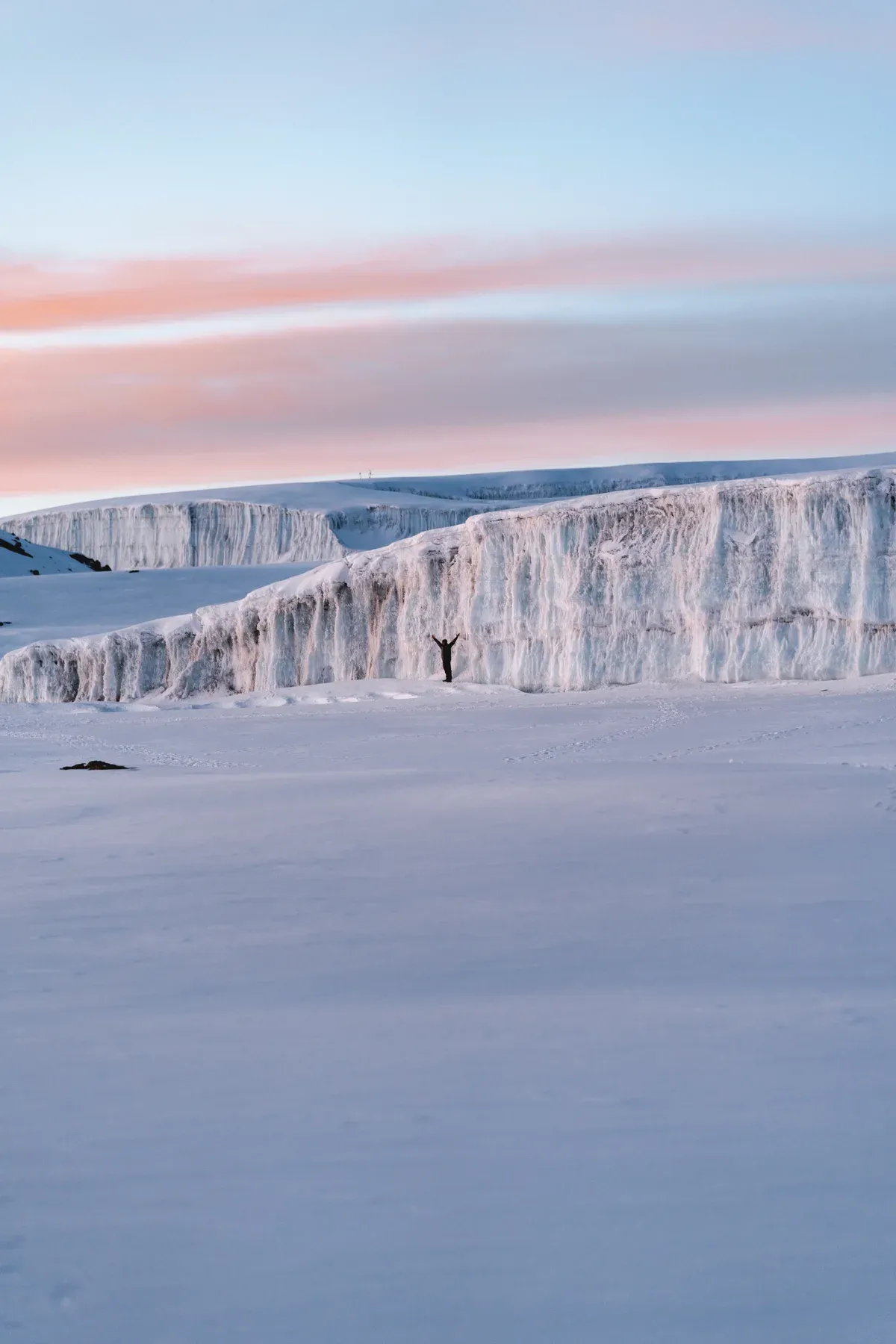
The Furtwängler Glacier in the Kibo crater. Photo: Altezzatravel, CC BY-SA 4.0, via Wikimedia Commons
Summit Tips
Five things to do and four to avoid, each with the reason, drawn only from the sources on this page.
Do
- Do start the night climb slowly, because the sources allow 4 to 10 hours to the rim.
- Do pack for -5 to -20 °C, because Footslopes Tours gives that as the summit-night range and the rim adds wind.
- Do accept the short summit stop, because Follow Alice allows about 15 minutes and Footslopes 15 to 30 minutes, so have your camera ready before you arrive.
- Do choose a route with enough acclimatisation days, because the 8-day Lemosho climbs add a day for it while the 5-day Marangu itineraries have fewer days.
- Do confirm what your price includes before booking, because the Marangu Route 5 Days Budget from Bush Lion at $1,350 leaves out the Moshi hotel night while the Altezza climbs include 2 hotel nights.
Don't
- Don't plan to climb the Western Breach, because Wikipedia records it closed as of 20 January 2024.
- Don't expect a long celebration at the sign, because operators allow only minutes at 5,895 m before the long walk down starts.
- Don't assume Stella Point or Gilman's Point is the summit, because both rim points sit below Uhuru Peak.
- Don't trust a single figure for the rim heights, because sources give 5,681 to 5,685 m for Gilman's Point and 5,739 to 5,756 m for Stella Point.
Uhuru Peak Questions
Is Uhuru Peak the top of Kilimanjaro?
Yes. It is the highest point of the Kibo cone and therefore the summit of Kilimanjaro and of Africa, at 5,895 m (19,341 ft) per TANAPA and UNESCO. The full story of the mountain's height is on Mount Kilimanjaro height.
How long does it take to get to Uhuru Peak?
Summit night itself takes 6 to 8 hours to the rim plus 30 to 60 minutes to the top per Footslopes Tours, though SummitClimb allows 6 to 10 hours plus 2 to 4 more. For the length of the whole climb route by route, see how long does it take to climb Kilimanjaro.
Can a beginner reach Uhuru Peak?
The routes are non-technical walks, but the altitude decides. Wikipedia gives an average success rate of 70 to 80 percent for about 50,000 trekkers a year, and the practical preparation is covered in climbing Mount Kilimanjaro.
What is the difference between Stella Point and Uhuru Peak?
Stella Point is the crater rim point at 5,756 m (18,885 ft) per Follow Alice and Nafika Tours, reached on the Machame, Lemosho and Umbwe listings, with Uhuru Peak another 30 to 60 minutes along the rim. The routes that use each rim point are compared under the routes compared.
What is the difference between Gilman's Point and Uhuru Peak?
Gilman's Point is the rim point for Marangu and Rongai at 5,681 m (18,638 ft) per Wikipedia, and the rim walk takes 30 to 60 minutes per Footslopes Tours. Both hut-based and camping options are covered under Marangu, Rongai and the 3-day trek.
How do I get a certificate for reaching Uhuru Peak?
Operators hand out certificates after the descent: Nafika Tours at Mweka Gate, Altezza Travel at its office after Mweka Gate and Zara Tours at Marangu Gate on the Rongai route. What a climb package includes beyond the certificate is explained under park fees and tips.