 Kilimanjaro Climbing Tours
Rongai Route: 7-Day Private Kilimanjaro Climb
The Rongai Route is the only Kilimanjaro climbing tour that approaches the mountain from the north, starting near the Kenyan border at Nalemuru Gate. This listing from Altezza Travel runs 9 days in total with 7 on the mountain, and it is private, so you climb with your own group and crew. The price is $3,993 per person and it includes park fees, 2 hotel nights at Aishi Machame Hotel, airport transfers, oxygen and Wilderness First Responder guides. This page sets out what that price covers, what you pay on top, the day-by-day route and who should pick a different listing. Compare it with the other Kilimanjaro climbing tours.
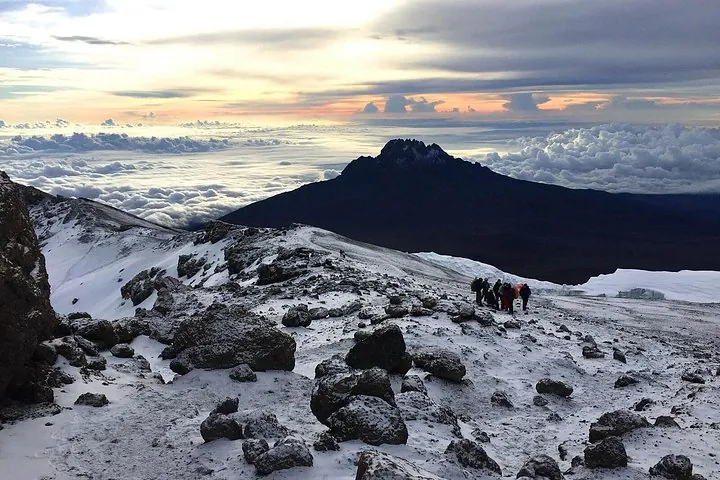
About This Tour
Altezza Travel runs this as a private 7-day climb of Kilimanjaro by the Rongai Route, the only route that approaches from the north near the Kenyan border. You camp at Simba, Second Cave, Kikilewa, Mawenzi Tarn and Kibo before the Uhuru Peak summit attempt, then descend the Marangu side by Horombo Hut to Marangu Gate. The listing calls Rongai the most picturesque and least crowded route.
The $3,993 per person price includes all fees collected by Kilimanjaro National Park, 2 nights at Aishi Machame Hotel with 2 guests per room, North Face VE-25 tents shared by 2 hikers, JRO airport pickup and drop-off, three meals a day on the mountain, oxygen tanks and oximeters, medical kits and medical check-ups. Visa, insurance, hotel lunches and dinners, gear hire and crew tips are not included. Cancel at least 24 hours before departure for a full refund.
$3,993, covering park fees, 2 hotel nights, airport transfers, tents, meals on the mountain and oxygen
9 days in total, 7 of them on the mountain
Kilimanjaro International Airport (JRO) pickup, then Aishi Machame Hotel, with an evening briefing on day 1 and a transfer to Nalemuru Gate on day 2
Uhuru Peak, 5,895 m, reached on summit night from School Hut at 4,715 m
Visa fees, insurance covering trekking to 6,000 m and helicopter evacuation, hotel lunch and dinner, personal gear (available for hire), crew tips, and a single room or tent supplement
Free cancellation up to 24 hours before departure for a full refund
Check Dates and Availability
This is a private tour with up to 15 people per booking. Check current availability on the listing before you commit flights.
You'll confirm the exact date and time on the secure booking page.
Quick answer Rongai Route at a glance
This private Rongai Route climb costs $3,993 per person, runs 9 days with 7 on the mountain, and tops out at Uhuru Peak, 5,895 m.
Key takeaways
- The price includes park fees, 2 hotel nights, airport transfers, oxygen and medical check-ups. See what the price covers.
- The route climbs from Nalemuru Gate at 2,020 m and descends by Horombo Hut to Marangu Gate. See the route day by day.
- Budget extra for the visa, hotel lunches and dinners, crew tips and insurance. Compare with the cheaper budget Rongai Route 7-day climb.
- Want a hut instead of tents? Look at the Marangu Route 5-day climb, which sleeps in huts.
What the Price Actually Covers
The $3,993 covers more than most budget listings, but several real costs sit outside it. Here is the split, taken from the listing itself.
Included
Altezza Travel includes all fees collected by Kilimanjaro National Park, so you do not pay at the gate. Two nights at Aishi Machame Hotel with 2 guests per room are in the price, as is JRO pickup and drop-off and all ground transport. On the mountain you get a North Face VE-25 tent shared by 2 hikers, group dining equipment, three meals a day with tea, coffee, juices and soda, and vegetarian, gluten-free and halal options on request.
The crew is a Certified Wilderness First Responder guide team plus porters, camp masters and cooks, and the listing adds oxygen tanks, oximeters, medical kits and daily medical check-ups.
| Line | In the price | Notes |
|---|---|---|
| Kilimanjaro park fees | Yes | All fees collected by Kilimanjaro National Park |
| Hotel before and after | Yes | 2 nights at Aishi Machame Hotel, 2 guests per room |
| Airport transfers | Yes | JRO pickup and drop-off, all ground transportation |
| Tents and dining kit | Yes | North Face VE-25, 2 hikers per tent |
| Meals | On the mountain | Three meals a day with drinks. Hotel lunch and dinner not included |
| Oxygen and medical | Yes | Oxygen tanks, oximeters, medical kits, medical check-ups |
| Visa | No | US$50 single entry, US$100 multiple entry, per the Tanzanian embassy |
| Insurance | No | Must cover trekking to 6,000 m and helicopter evacuation |
| Gear and sleeping bag | No | Personal equipment available for hire from the operator |
| Crew tips | No | Tips for the mountain support crew are an exclusion |
| Single room or tent | No | Available at extra charge |
What to Budget on Top
Nothing is marked as a mandatory extra by the booking platform, but the honest list is real. The Tanzanian embassy lists the ordinary single-entry visa at US$50 and the multiple-entry visa at US$100. Hotel lunch and dinner are not included, so you pay for those meals yourself.
Tips for the mountain support crew are excluded, and one operator listing in this comparison suggests US$250 to US$300 per hiker as a tip level. Insurance covering trekking up to 6,000 m (19,685 ft) and helicopter evacuation is excluded and highly recommended, because, as one operator notes, the park rescue fee does not cover a full helicopter evacuation. Personal gear including boots and a sleeping bag is available for hire.
Ask the operator about the single supplement if you want your own room or tent.
Sources: Wikipedia, Mount Kilimanjaro, UNESCO, Kilimanjaro National Park
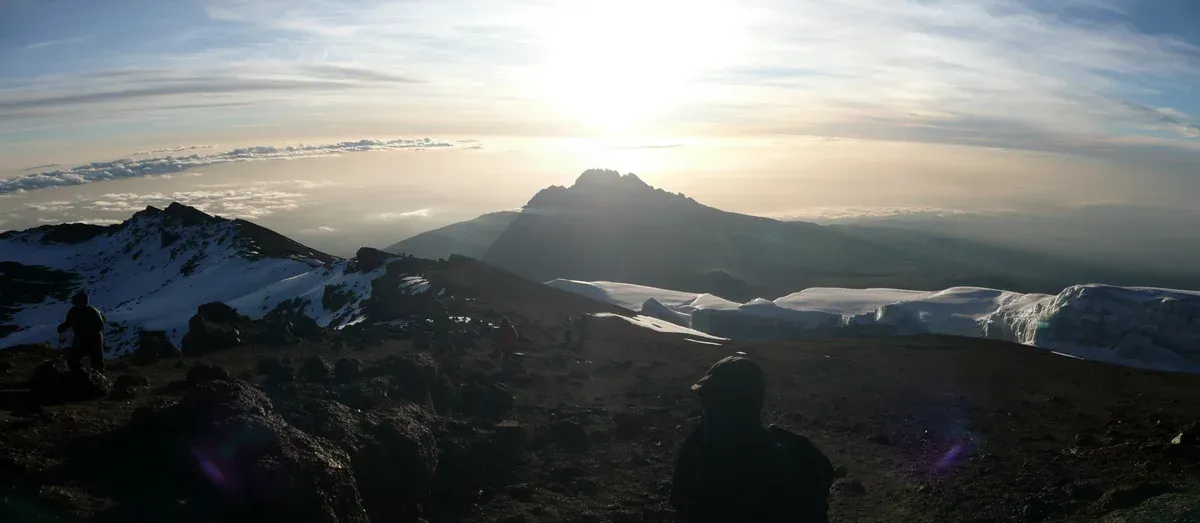
Mawenzi at sunrise from the crater rim. Photo: Sbork, CC BY-SA 3.0, via Wikimedia Commons
The Route Day by Day
Rongai starts at Nalemuru Gate at 2,020 m on the dry north side, the only route that approaches Kilimanjaro from the north. It climbs through coniferous forest and high camp stages to Kibo, then descends the Marangu side, so you see two faces of the mountain. Heights below are the figures the listing states.
The Climbing Days
Day 2 is the forest walk from Nalemuru Gate (2,020 m) to Simba Camp at 2,625 m. Day 3 moves to Second Cave Camp at 3,480 m in about 3 hours, then adds an acclimatisation hike toward Kikilewa Camp with a 100 m gain before dropping back down. Day 4 is a relief day at Kikilewa Camp at 3,630 m, where the listing says Kibo shows at its best in clear weather.
Day 5 heads to Mawenzi Tarn Camp at the foot of Mawenzi, Kilimanjaro's second cone, with a 200 m acclimatisation gain in the afternoon. Day 6 crosses rocky semidesert to Kibo Summit Camp at 4,700 m. Summit night starts from School Hut at 4,715 m for the 5,895 m push to Uhuru Peak, then the team descends all the way to Horombo Hut on the Marangu side before the final walk out to Marangu Gate and the drive back to the hotel.
| Day | Stage | Height |
|---|---|---|
| 1 | Arrival at JRO, transfer to Aishi Machame Hotel, evening briefing | Hotel |
| 2 | Nalemuru Gate to Simba Camp | 2,020 m to 2,625 m |
| 3 | Simba Camp to Second Cave Camp, plus acclimatisation hike | 3,480 m, hike gain 100 m |
| 4 | Second Cave Camp to Kikilewa Camp | 3,630 m |
| 5 | Kikilewa Camp to Mawenzi Tarn Camp | Height not stated in this listing, acclimatisation gain 200 m |
| 6 | Mawenzi Tarn Camp to Kibo Summit Camp | 4,700 m |
| 7 | Summit night from School Hut to Uhuru Peak, descend to Horombo Hut | 4,715 m to 5,895 m |
| 8 | Horombo Hut to Marangu Gate, return to the hotel | Height not stated in this listing |
| 9 | Departure, JRO drop-off | Not stated |
The Acclimatisation Logic
Seven days on the mountain with two built-in acclimatisation hikes is the strength of this itinerary. Climb high, sleep low is the pattern on days 3 and 5, and the listing tells you to treat those short hikes seriously because they raise your summit chances and cut altitude sickness risk. It also sets ground rules from day 2: no alcohol or caffeine, at least 4 liters of water a day in small frequent doses, and a talk with your doctor about Diamox before you travel.
Wikipedia reports that about 40 percent of people get acute mountain sickness after a rapid ascent to 3,000 m, so symptoms are common and not a failure. Tell your guide about any headache, nausea or fatigue, because the crew carries oxygen and runs medical check-ups for a reason. Weather and altitude decide the summit, not the itinerary, and no operator can promise Uhuru Peak.
Who This Trip Rules Out
This listing fits travellers who want a private, well-equipped climb on a quiet route and can meet its price and its physical demands. It is wrong for several groups, and here are the alternatives.
Budget Travellers
At $3,993 per person this is one of the dearer listings on the site. The price buys hotel nights, transfers and oxygen, which helps, but if the number is the problem, the Rongai Route 7 Days Budget climb at $2,000 per person covers park fees on the same quiet north side. Note that listing has no reviews yet and airport transfers and hotel nights are not included, so budget for those.
People Who Cannot Camp
The camps on the way up are in North Face VE-25 tents. If you want a bed and walls, the Marangu Route 5 Days climb sleeps in park huts the whole way and costs $2,402.60 per person. The trade-off is a shorter route with fewer days to acclimatise.
Travellers Who Want the Longest Quiet Route
If you have the budget and want more days at altitude than Rongai gives, the Northern Circuit Route 8 Days climb by the same operator costs $4,554 per person, runs 10 days with 8 on the mountain and circles the mountain with very low traffic.
Anyone Outside the Age Band or Fitness Band
The booking age band runs from 13 to 70 and an adult must be on the booking. The listing requires at least a moderate level of physical fitness and is not recommended for travellers with spinal injuries, poor cardiovascular health or pregnancy. If you sit outside that band, the Machame Route 6 Days climb books ages 16 to 80 in a shared group for $2,350 per person.
Altitude, Season and Paperwork
Everything here comes from published sources on Kilimanjaro's routes, fees and conditions. Read it before you book flights.
When to Climb Rongai
Altezza Travel gives the dry seasons as January to mid-March and June to October, with rains from late March to May and November to late December. Wikipedia gives the average summit temperature as about minus 7 degrees Celsius (19 F), and guides put arctic-zone nights at minus 20 to minus 10 C. Pack for cold on summit night no matter the season. More detail is in the guide to the best time to climb Kilimanjaro.
Altitude and Acclimatisation
Uhuru Peak at 5,895 m (19,341 ft) is in the extreme altitude band, above 5,500 m. Wikipedia says about 40 percent of people develop acute mountain sickness after a rapid ascent to 3,000 m, and that HAPE and HACE, the severe forms, can be fatal. Acute mountain sickness usually starts with a headache plus nausea, vomiting, loss of appetite or fatigue.
Follow the listing's rules from day 1: drink at least 4 liters of water a day, avoid alcohol and caffeine, keep a slow pace, and ask your doctor about Diamox. This 7-day itinerary with two acclimatisation hikes gives your body more time than a 5 or 6-day route. Alert the guide to any symptom, because oxygen and medical check-ups are on board.
Summit Night
The team leaves School Hut at 4,715 m in the dark and climbs through the night, putting the strain on your cardiovascular system rather than your muscles. Expect cold, expect a slow pace, and expect only a short time at the top before the descent. Operators describe reaching Stella Point around sunrise, with Uhuru Peak further along the rim.
Weather decides what you see. The guide to Uhuru Peak covers what the summit is like.
Getting There
You fly into Kilimanjaro International Airport (JRO), which Wikipedia puts about 40 km from Moshi and about 60 km from Arusha. Airlines serving JRO include KLM, Qatar Airways, Turkish Airlines, Ethiopian Airlines, Kenya Airways and Air France. The listing includes your JRO pickup and drop-off, so you do not need a separate transfer booking.
The Kilimanjaro airport guide has the practical details.
Fees, Visa, Tips and Insurance
The park fees are in this price, which matters. The official TANAPA tariff sets the Kilimanjaro conservation fee at US$70 per person per day for visitors aged 16 and over, plus 18 percent VAT as the booklet states its charges are VAT-exclusive, and a US$20 rescue fee per trip. The Tanzanian embassy lists the single-entry visa at US$50 and the multiple-entry visa at US$100, applied for through the e-visa system.
Tips for the mountain support crew are excluded, and one operator in this comparison states US$250 to US$300 per hiker as a guide, though no official rate exists. The listing excludes insurance, and operators recommend cover for trekking up to 6,000 m (19,685 ft) including helicopter evacuation, because, as one operator notes, the park rescue fee does not cover a full helicopter lift-off. See the cost to climb Kilimanjaro guide for the full picture.
The Trip in Steps
The listing's own structure: arrival, 7 days on the mountain, departure.
-
Day 1
Arrival and briefing
Land at Kilimanjaro International Airport (JRO), where a representative meets you in arrivals and drives you to Aishi Machame Hotel. Check-in starts at 2:00 PM. An evening briefing with the operator's managers covers kit and readiness.
-
Day 2
Nalemuru Gate to Simba Camp
Morning transfer to the park's northern entrance at Nalemuru Gate, 2,020 m, for permits and search and rescue registration. A moderate forest trek to Simba Camp at 2,625 m. The crew has tents pitched and dinner started when you arrive.
-
Days 3 and 4
Second Cave and the relief day
An easy 3-hour walk to Second Cave Camp at 3,480 m, then an acclimatisation hike toward Kikilewa with a 100 m gain. Day 4 moves to Kikilewa Camp at 3,630 m with time to rest, and the guide checks everyone's health in the evening.
-
Day 5
Mawenzi Tarn
Trek to Mawenzi Tarn Camp at the foot of Mawenzi, Kilimanjaro's second cone. After lunch comes a 200 m acclimatisation hike toward the volcano, then back down to camp for dinner.
-
Day 6
Kibo Summit Camp
Across rocky semidesert to Kibo Summit Camp at 4,700 m. Sleep early, drink plenty, avoid strenuous effort. The summit attempt starts tonight.
-
Day 7
Summit night and descent
Depart School Hut at 4,715 m in the dark for Uhuru Peak at 5,895 m, weather permitting. Then a long descent down the Marangu side to Horombo Hut the same day.
-
Days 8 and 9
Out through Marangu Gate and departure
Finish at Marangu Gate, return to Aishi Machame Hotel, then a JRO drop-off for your flight home.
What Works and What Does Not
An honest read of this listing against the rest of the field.
What we genuinely like
- Park fees, 2 hotel nights and airport transfers are in the $3,993, so the on-the-ground costs are largely settled before you fly
- Oxygen tanks, oximeters, medical kits and daily medical check-ups are included
- Seven days on the mountain with two acclimatisation hikes, on the quiet north side of the mountain
- Private tour with Certified Wilderness First Responder guides and a full porter, camp master and cook crew
- Free cancellation up to 24 hours before departure, and 57 reviews at 5.0 on the platform
The honest downsides
- At $3,993 per person it costs more than the $2,000 budget Rongai listing, which leaves out airport transfers and hotel nights
- Hotel lunch and dinner, visa, insurance, gear hire and crew tips are all excluded, and those extras are real money
- Tent camps on the mountain, with summit-zone nights that sources put at minus 20 to minus 10 C
- Single travellers pay a supplement for a single room or tent
- The listed age band tops out at 70 and the route is excluded for spinal injuries, poor cardiovascular health and pregnancy
Who it's NOT for: Travellers on a tight budget, anyone who refuses to camp, and people outside the 13 to 70 age band should book a different listing.
Questions About This Rongai Route Climb
Is the park fee included in the $3,993 price?
Yes, the listing includes all fees collected by Kilimanjaro National Park. For context on what those fees are, the Kilimanjaro National Park guide explains the TANAPA tariff.
How long is the Rongai Route?
This itinerary runs 9 days with 7 on the mountain, and Wikipedia puts the Rongai route length at about 65 km. The page on how long it takes to climb Kilimanjaro compares itinerary lengths.
Do I need my own sleeping bag and boots?
Personal gear such as boots and a sleeping bag is not in the price, but the operator lists it for hire. The tents, dining kit, meals and drinks on the mountain are in the price. See the cost to climb Kilimanjaro guide for budgeting the extras.
Where does the climb start and finish?
It starts with a pickup at Kilimanjaro International Airport (JRO) and a night at Aishi Machame Hotel, then the trek begins at Nalemuru Gate on the north side. It ends at Marangu Gate with a return to the hotel. The Kilimanjaro airport guide covers flights and arrivals.
What is the summit night like on Rongai?
You leave School Hut at 4,715 m in the dark and climb to Uhuru Peak at 5,895 m, with sources putting night temperatures in the arctic zone at minus 20 to minus 10 C. The Uhuru Peak guide describes the top.
Is Rongai less crowded than Machame or Marangu?
The listing calls it the least crowded route, and Rongai is the only route approaching from the north. If low traffic matters most to you, compare the Northern Circuit Route 8 Days, which circles the mountain with very low traffic.
Can I pay less for the same route?
Yes, the Rongai Route 7 Days Budget climb costs $2,000 per person with park fees included, though it has no reviews and leaves out airport transfers and hotel nights. The comparison of Kilimanjaro climbing tours sets all the listings side by side.
Prices, availability and terms are set by the operator and confirmed at checkout.
We may earn a commission if you book through one of our links, at no extra cost to you. Full affiliate disclosure