 Kilimanjaro Climbing Tours
Climbing Mount Kilimanjaro: How Hard It Is and How the Climb Works
Climbing Mount Kilimanjaro means walking to 5,895 m (19,341 ft) without ropes or technical climbing. This guide covers what the climb actually demands: fitness, altitude, summit night, the crew around you, success rates and training. It also links the practical pages: the routes, the cost and the season. If you are comparing Kilimanjaro climbing tours, start with the Kilimanjaro climbing tours compared and come back here for the honest detail on difficulty and day-to-day life on the mountain.
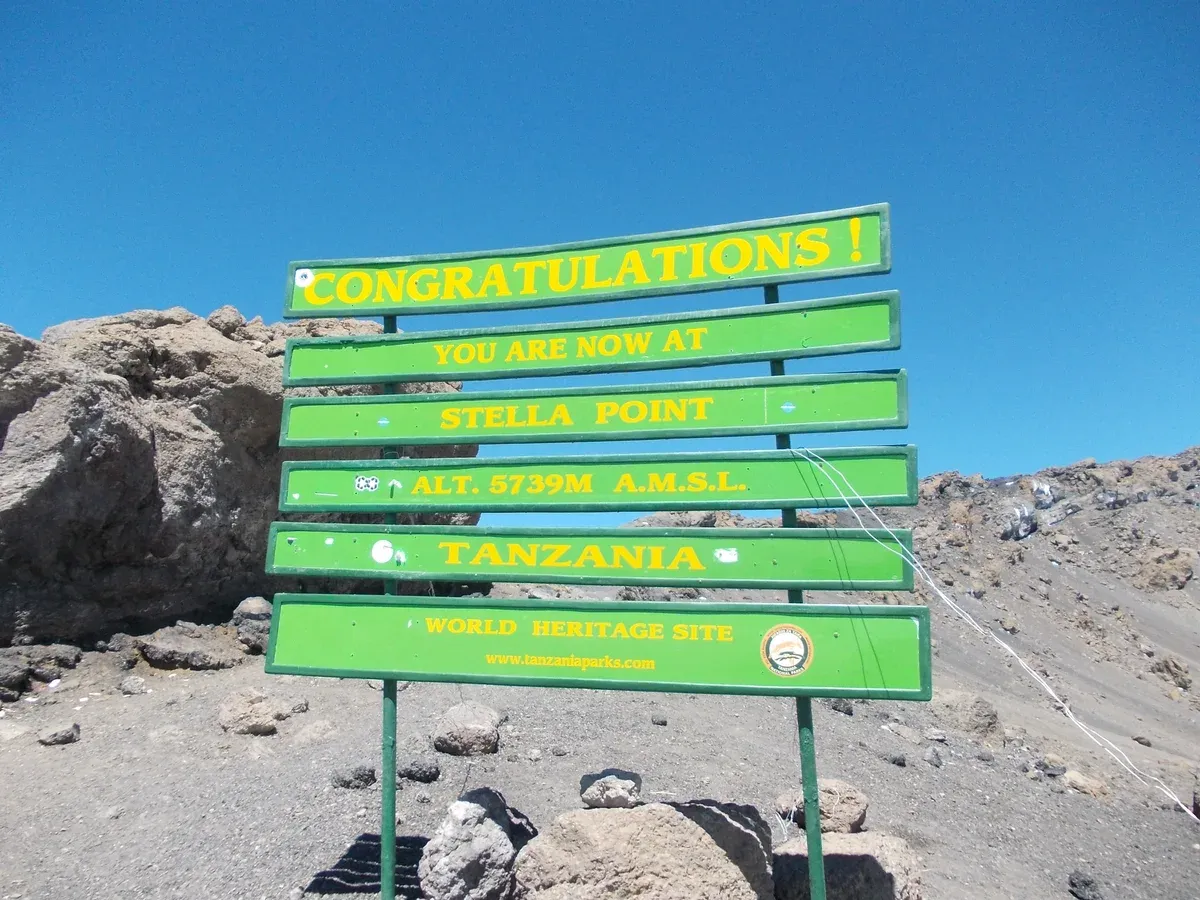
The Stella Point sign on the crater rim. Photo: Caelo80, CC BY-SA 3.0, via Wikimedia Commons
Quick answer The short answer
Climbing Mount Kilimanjaro is a non-technical trek: no ropes or climbing experience are needed, but you walk to 5,895 m (19,341 ft), and altitude is the main difficulty.
Key takeaways
- Difficulty, altitude and the guide rule are covered in how hard it is below.
- The pick for a first climb is the private 7-day Lemosho Route 7 Days at $3,959 per person with park fees and oxygen included.
- For the longest route on the mountain, see the Northern Circuit Route 8 Days at $4,554 per person.
- Choosing between the seven paths is a page of its own: Kilimanjaro routes.
How Hard It Is and Who Can Do It
Kilimanjaro is a walk-up peak, but the numbers explain why people still turn back.
No Technical Climbing, but a Licensed Guide Is Required
Adventure Consultants states plainly that no technical climbing or rope skills are required on Kilimanjaro. You hike. The paths are walking trails, and the Barranco Wall is the best-known scramble, walked with a guide in front of you. What the mountain does demand is days of sustained walking at height.
Park rules require climbers to enter through authorised gates with a licensed guide and to book through licensed operators, according to Footslopes Tours. You cannot climb Kilimanjaro solo. Every booking on this site is a guided trip, and the crew behind you is covered in a day on the mountain.
The minimum permit age is 10 years per Wikipedia, although it also records a 7-year-old, Keats Boyd, summited in 2008. Individual tours set their own bands: the Machame Route 6 Days books ages 16 to 80, the Lemosho Route 7 Days books 13 to 95 with an adult on the booking. The oldest recorded summiteer, Anne Lorimor, was 89 years and 37 days old per Wikipedia. Altezza Travel lists the climb as not recommended for pregnant travellers, people with spinal injuries or poor cardiovascular health.
Hill walking, swimming, light running or biking and gym strength work are the training Adventure Consultants recommends. The route you pick shapes everything else, and the trade-offs live on Kilimanjaro routes.
Altitude Is the Real Difficulty
Wikipedia classifies anything above 5,500 m as extreme altitude, and Uhuru Peak sits at 5,895 m (19,341 ft). Adventure Consultants says most people begin to feel the effects above 3,500 m. SummitClimb adds that above 5,300 m the body can no longer acclimatise permanently, so summit night is a race against a clock your body is losing.
The study figures are sobering and worth reading before you book. Wikipedia reports a retrospective study of 917 Lemosho and Machame climbers in which 70.4 percent had acute mountain sickness. A July and August 2005 study found 77 percent of climbers had AMS and only 61.3 percent reached the summit. Acute mountain sickness starts with a headache plus nausea, vomiting, loss of appetite or fatigue. The severe forms, HAPE (fluid in the lungs) and HACE (swelling of the brain), can be fatal, and Wikipedia says immediate descent is the only definite and reliable treatment.
The practical advice attached to these numbers is consistent across operators. Altezza Travel tells climbers to avoid alcohol and caffeine, drink over 4 litres of water daily and consult a doctor about Diamox (acetazolamide, 125 mg twice daily per the CDC figure Wikipedia cites) before the trip. Wikipedia says sleeping altitude should not rise more than 300 m (1,000 ft) per day, which is exactly why longer itineraries succeed more often. Operators such as the booking platform listings for Zara Tours include pulse oximeters and a first aid kit, and some, like ZAFS Tours and Habari Adventure, carry emergency oxygen. A review quoted by Zara Tanzania Adventures recommends testing oxygen saturation and pulse daily.
How long you should spend on the mountain is its own question, answered on how long to climb Kilimanjaro.
Sources: Wikipedia, Adventure Consultants
A Day on the Mountain
You carry a daypack. Everything else is done by a crew that can outnumber you several times over.
The Crew Around You
A Kilimanjaro climb is a supported expedition. Duma Explorer lists a typical crew for two climbers as 1 lead guide, 1 assistant guide, 1 cook and 6 to 7 porters, and Mountkilimanjaroguide.com says groups typically have 3 to 5 staff per climber. Wikipedia counted about 11,000 guides, porters and cooks working on the mountain in 2007.
KPAP, the Kilimanjaro Porters Assistance Project founded in 2003, requires at least three porters per climber on most routes and two on Marangu, and caps each porter's load at 20 kg (about 44 lb) excluding personal kit, though SummitClimb says porters may carry up to 18 kg as regulated by the national park. The table below compares the roles and where each figure comes from.
| Role | What they do | Source |
|---|---|---|
| Lead guide | Runs the climb, monitors health, decides on turnaround or descent. Altezza Travel uses Certified Wilderness First Responder guides, Adventure Consultants says its Tanzanian guides are certified and medically trained, and SummitClimb's head guide has summited over 100 times | Operator listings |
| Assistant guide | Second qualified guide. Altezza Travel assigns one guide for every two climbers on summit night | Altezza Travel |
| Cook | Cooks all meals at camp. Part of the standard crew of 1 guide, 1 assistant guide, 1 cook and 6-7 porters for a pair | Duma Explorer |
| Porters | Carry tents, food, water and gear. KPAP member companies cap the load at 20 kg excluding personal kit, and KPAP requires a minimum porter wage of TZS 20,000 per day paid within two days after the expedition | KPAP via Wikipedia and kiliporters.org |
Hiking Hours, Meals and Sleeping
A normal trekking day starts with breakfast at camp, then a day of walking with a lunch break. The opening stage of Machame, Machame Gate to Machame Camp, is quoted by operators at 11 km in 5 to 7 hours, though another operator gives about 18 km, so stage lengths are disputed. Altezza Travel schedules short acclimatisation hikes each afternoon, such as 200 to 300 m of gain towards Lava Tower after reaching camp, and says the guide may skip Lava Tower (4,630 m) and use the porter trail, topping out at about 4,400 m, if someone is not acclimatising.
Meals are cooked by the crew. Altezza Travel supplies North Face VE-25 tents shared by two hikers plus group dining equipment. Sleeping is in tents on every route except Marangu. Marangu is the only route with hut accommodation, per Wikipedia, climbing through Mandara Hut at 2,743 m, Horombo Hut at 3,760 m (3,720 m per Duma Explorer) and Kibo Hut at 4,730 m, with an optional acclimatisation day at Horombo.
Where the day takes you depends entirely on the path. The full comparison of routes is on Kilimanjaro routes, and what the nights cost is on cost to climb Kilimanjaro.
Summit Night
The hardest and most memorable part of climbing Mount Kilimanjaro happens in the dark.
Midnight Start, Sunrise at Stella Point
Base camps sit typically around 4,600 to 4,800 m per Follow Alice, at places like Barafu Camp (4,640 m) or Kibo Hut. From there the summit push starts in the middle of the night. Follow Alice schedules an 11:00 pm wake-up and a midnight start. Nafika Tours wakes climbers at midnight for tea and a light breakfast, then allows 4 to 5 hours to reach Stella Point at sunrise. Footslopes Tours puts the start between 11 pm and midnight with 6 to 8 hours to Stella Point. Zara Tours' Marangu itinerary leaves at 1 AM and targets Uhuru Peak by about 9 AM, and on Rongai it wakes climbers around midnight, reaching Gilman's Point after about six hours. On Marangu the scree climb goes to Gilman's Point (5,681 m per Wikipedia) and then around the crater rim to Uhuru Peak, about two hours for able climbers.
The distances are brutal for the hour. Altezza Travel states the Machame summit day covers 15 km and takes 8 to 12 hours. SummitClimb says the summit climb takes 6 to 10 hours depending on fitness, plus 2 to 4 hours on the final ascent. Stella Point is given as 5,756 m by Follow Alice and Nafika Tours, and it is about one hour from Stella Point to Uhuru Peak, per Nafika Tours, with Follow Alice saying about 30 minutes.
It is cold and windy above 5,000 m in the dark, which is why operators insist on layered clothing, gloves and a head torch. Altezza Travel assigns one guide for every two climbers on summit night specifically so pacing and health checks stay tight. Follow Alice says to expect only about 15 minutes at the summit before descending.
The descent is not a rest. Altezza Travel notes that 90 percent of accidents occur on the descent, including all broken limbs, and warns of toenail damage. Nafika Tours quotes 12 to 15 hours of hiking on summit day including the descent to Millennium Camp (about 3,800 to 3,950 m depending on source), then a couple of hours to Mweka Gate the next day. The season you choose changes the conditions you will face, covered on best time to climb Kilimanjaro.
Sources: Follow Alice, Footslopes Tours
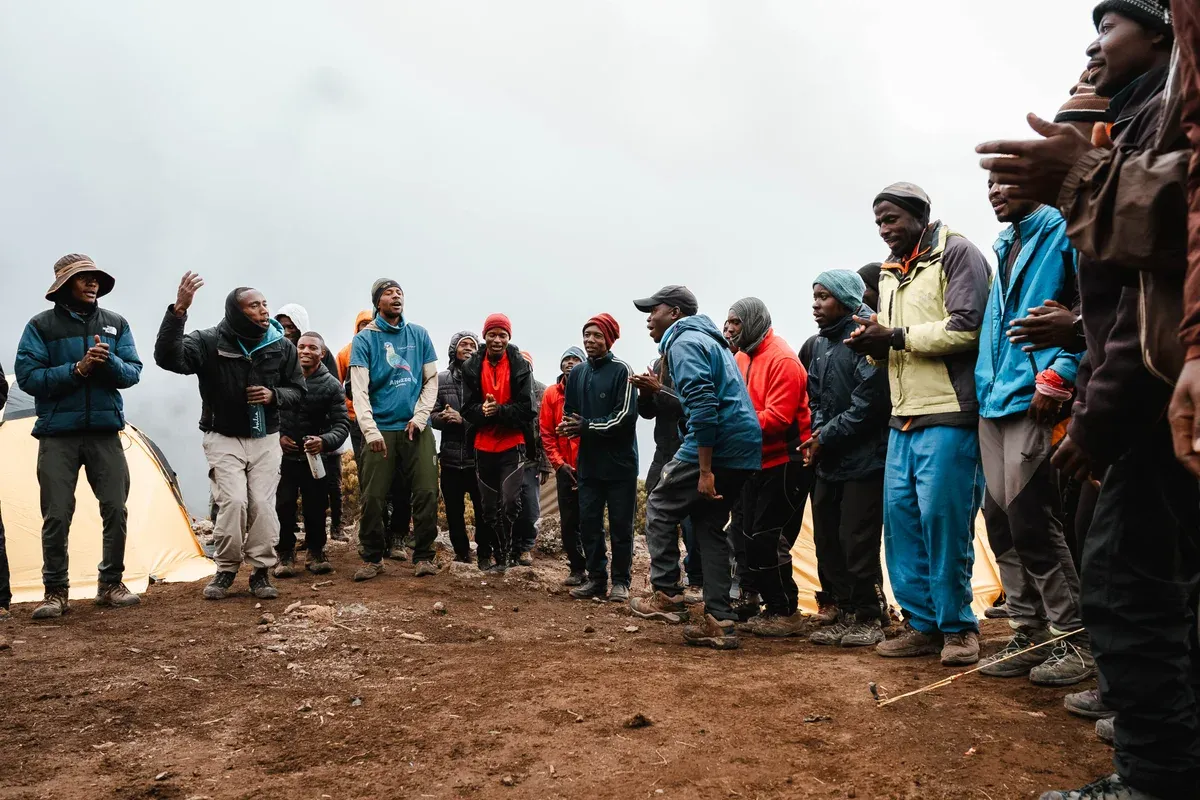
Porters at one of the higher camps. Photo: FokshaAnatolii, CC BY-SA 4.0, via Wikimedia Commons
Success Rates and How to Raise Yours
Every success figure on Kilimanjaro is attributed and unaudited, so read them as ranges.
What the Numbers Say, and Why They Disagree
Wikipedia says 70 to 80 percent of the roughly 50,000 trekkers a year succeed on average. Follow Alice cites a 2006 park-authority dataset with an overall success rate of 45 percent, split 27 percent on 5-day, 44 percent on 6-day, 64 percent on 7-day and 85 percent on 8-day itineraries, and says itself that this data is unverified and not updated. SummitClimb claims over 98 percent to Uhuru Peak. These cannot all be right: Follow Alice notes that group size, itinerary length, guide practices and the definition of summit all change quoted rates, and Duma Explorer says about 35,000 attempts a year produce an estimated 25,000 to 30,000 summits, with operator rates self-reported and unaudited.
By route, Duma Explorer claims about 90 percent on Lemosho, 85 percent on 7-day Machame, 50 to 80 percent on Marangu, about 80 percent on 7-day Rongai, above 90 percent on the Northern Circuit and about 70 percent on Umbwe. The Davies et al. 2009 Marangu study found 111 of 181 trekkers with complete data, 61 percent, reached the summit. Climb Mount Kilimanjaro says Marangu has the lowest summit success of the routes, driven by its shortest itinerary.
The single biggest lever is days on the mountain. Duma Explorer averages 27 to 35 percent for 5 days, 50 to 73 percent for 6, 80 to 85 percent for 7, over 90 percent for 8 and 90 to 95 percent for 9. Much Better Adventures says a seven-day Machame has a much higher success rate than a six-day one, and Altezza Travel says dry-season climbs succeed more often because of better weather. Longer trips cost more, and the arithmetic is on cost to climb Kilimanjaro.
Three bookable climbs show the range. The 8-day Lemosho Route 8 Days costs $3,200 per person and adds an acclimatisation day. The 7-day Machame Route 7 Days costs $2,425 per person with daily health checks. The 8-day Northern Circuit Route 8 Days costs $4,554 per person on the longest route at about 88 to 90 km. Training (hill walking, swimming, light running or biking and gym strength work, per Adventure Consultants) and full gear, hireable from operators like Altezza Travel and Zara Tours, close the remaining gap.
Sources: Wikipedia, Follow Alice, Duma Explorer
Tips for Climbing Kilimanjaro
Do
- Do book at least 7 days on the mountain, because Duma Explorer's averages show success jumping from 50 to 73 percent on 6 days to 80 to 85 percent on 7.
- Do drink over 4 litres of water daily and skip alcohol and caffeine, because Altezza Travel gives this as core acclimatisation advice.
- Do ask a doctor about Diamox before you travel, because Wikipedia cites a CDC preventive dose of acetazolamide 125 mg twice daily for rapid ascents above 2,700 m.
- Do walk downhill in training and pack for the descent, because Altezza Travel says 90 percent of accidents occur on the way down, including all broken limbs.
- Do check that your operator follows KPAP standards, because Duma Explorer claims about 70 percent of expeditions do not comply, and KPAP member companies cap porter loads at 20 kg.
Don't
- Don't pick a 5-day itinerary to save money, because Follow Alice's 2006 dataset puts 5-day success at 27 percent.
- Don't ignore a headache with nausea or fatigue above 3,500 m, because Wikipedia says these are how acute mountain sickness starts and immediate descent is the only reliable treatment for severe cases.
- Don't count on the Western Breach, because per Wikipedia it has been closed since 20 January 2024.
- Don't expect the climb to be technical, because Adventure Consultants confirms no ropes or climbing skills are needed, so your training budget is better spent on long hill walks.
Climbing Mount Kilimanjaro: Questions
Do I need oxygen to climb Kilimanjaro?
Not necessarily. Several operators carry emergency oxygen, including ZAFS Tours and Habari Adventure, and some packages include it, while Zara Tours' Machame listing names it as not included. See what each package includes on the homepage comparison.
Is Kilimanjaro harder than Everest?
They are different tests. Everest requires technical mountaineering at extreme altitude, while Kilimanjaro needs no climbing skills at all. The challenge is trekking to 5,895 m (19,341 ft) in days rather than weeks, which is why acclimatisation time matters so much. Route choices are compared on Kilimanjaro routes.
What is the fastest time to climb Kilimanjaro?
Wikipedia records Karl Egloff's 13 August 2014 run from Umbwe Gate to the summit in 4 hours 56 minutes and back to Mweka Gate in 6 hours 42 minutes. Ordinary trekkers take 5 to 9 days, laid out on how long to climb Kilimanjaro.
What is the success rate of climbing Mount Kilimanjaro?
Wikipedia gives 70 to 80 percent on average for about 50,000 trekkers a year, while Follow Alice cites a 2006 park dataset at 45 percent overall, and operator claims run higher. All figures are attributed and unaudited. The full breakdown is in success rates above.
Can you climb Kilimanjaro without experience?
Yes. Adventure Consultants states no technical climbing or rope skills are required, and a licensed guide is mandatory on every route anyway. What you need is fitness and a long enough itinerary. The budget 7-day Lemosho Route 7 Days Budget at $1,960 per person is a first-timer option with park fees and oxygen included.
How hard is it to climb Kilimanjaro compared to other treks?
The walking itself is moderate, but base camps typically sit around 4,600 to 4,800 m, and studies show most climbers feel acute mountain sickness on the way up. Training guidance and the AMS figures are in how hard it is.